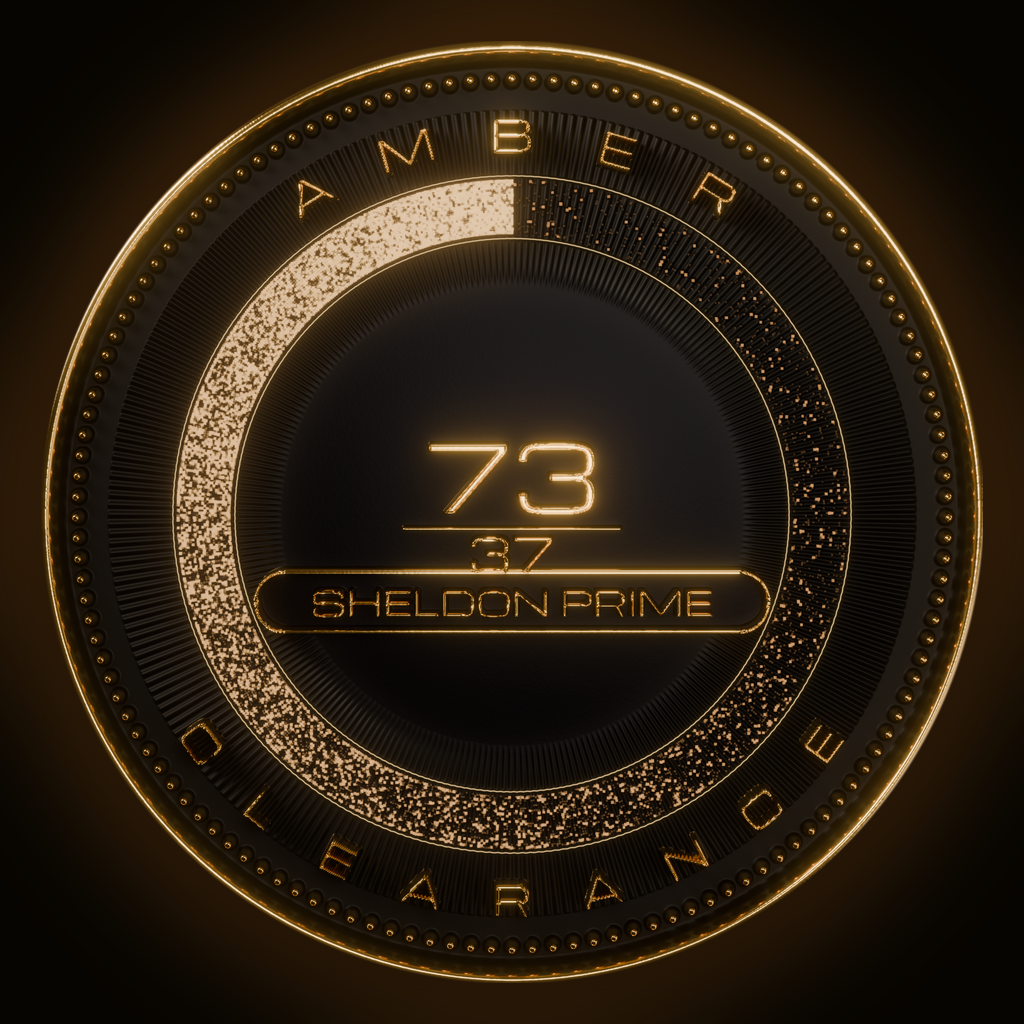
The Sheldon Prime
The best number there is — and the only one that can prove it.
Seventy-three is, by a well-known argument, the best number there is — and unlike most such claims, this one has been proved. What follows is its case, laid out the way the number itself prefers: in symmetries.
Begin with its rank. Seventy-three is the 21st prime number — and twenty-one is the product of its own two digits: 7 × 3. The number has already begun to describe itself.
Now reverse it. Thirty-seven — the digits of 73 turned around — is the 12th prime, and 12 is 21 reversed. The rank mirrors when the number mirrors. A prime that becomes a different prime under reversal is called an emirp ("prime" spelled backwards); 37 and 73 are the most celebrated emirp pair in the literature.
The symmetry does not stop in base ten. Written in binary, 73 is 1001001 — a palindrome, identical read in either direction, seven digits long with exactly three of them set. Seven and three again, now in the language of the machine.
These properties were first catalogued, with characteristic confidence, by the physicist Sheldon Cooper, who in 2010 pronounced 73 "the best number" and dared the world to do better. For nine years it was a television flourish. Then, in 2019, the number theorists Carl Pomerance and Chris Spicer published Proof of the Sheldon Conjecture in the American Mathematical Monthly and settled it: 73 is the unique prime that possesses both the product property and the mirror property. Not the best by taste — the only one of its kind, provably, among all the primes that are or ever will be. The literature now calls it, simply, the Sheldon prime.
Struck in onyx and gold, the medallion sets 73 above its reflection, 37, divided by a single rule and sealed beneath the legend SHELDON PRIME. This example — No. 073 — is held in the founder's own collection, the cornerstone of Club Amber's opening series. Its mirror, No. 037, resides quietly with an early member of the club; the twin primes have never been shown as a pair, and are unlikely ever to be.
A number that is rare not by convention and not by scarcity, but by proof.
There is exactly one Sheldon prime. This is its number.
Club Amber · The Amber Exchange — a saleroom for the rarest numbers ever made.
About Club Amber →